The short answer
Autophagy is the process your cells use to break down and recycle their own worn-out parts. It's real, it's essential, and its discovery won the 2016 Nobel Prize. Fasting reliably increases autophagy in cells and animals, but in humans no study has shown when it "starts" during a fast, how much a fast raises it, or whether that improves health. Anyone giving you an exact hour is guessing.
How a Nobel Prize became a TikTok timeline
You've probably seen the graphic. Hour 12: fat burning. Hour 16: autophagy begins. Hour 72: "full cellular renewal." It's tidy, it's motivating, and nobody has measured it in people.
We sell a 3-day fasting kit, so repeating that timeline would be easy for us. We're not going to. Here's what autophagy actually is, what the human research does and doesn't show, and why we'd rather you fast for reasons you can check.
What is autophagy?
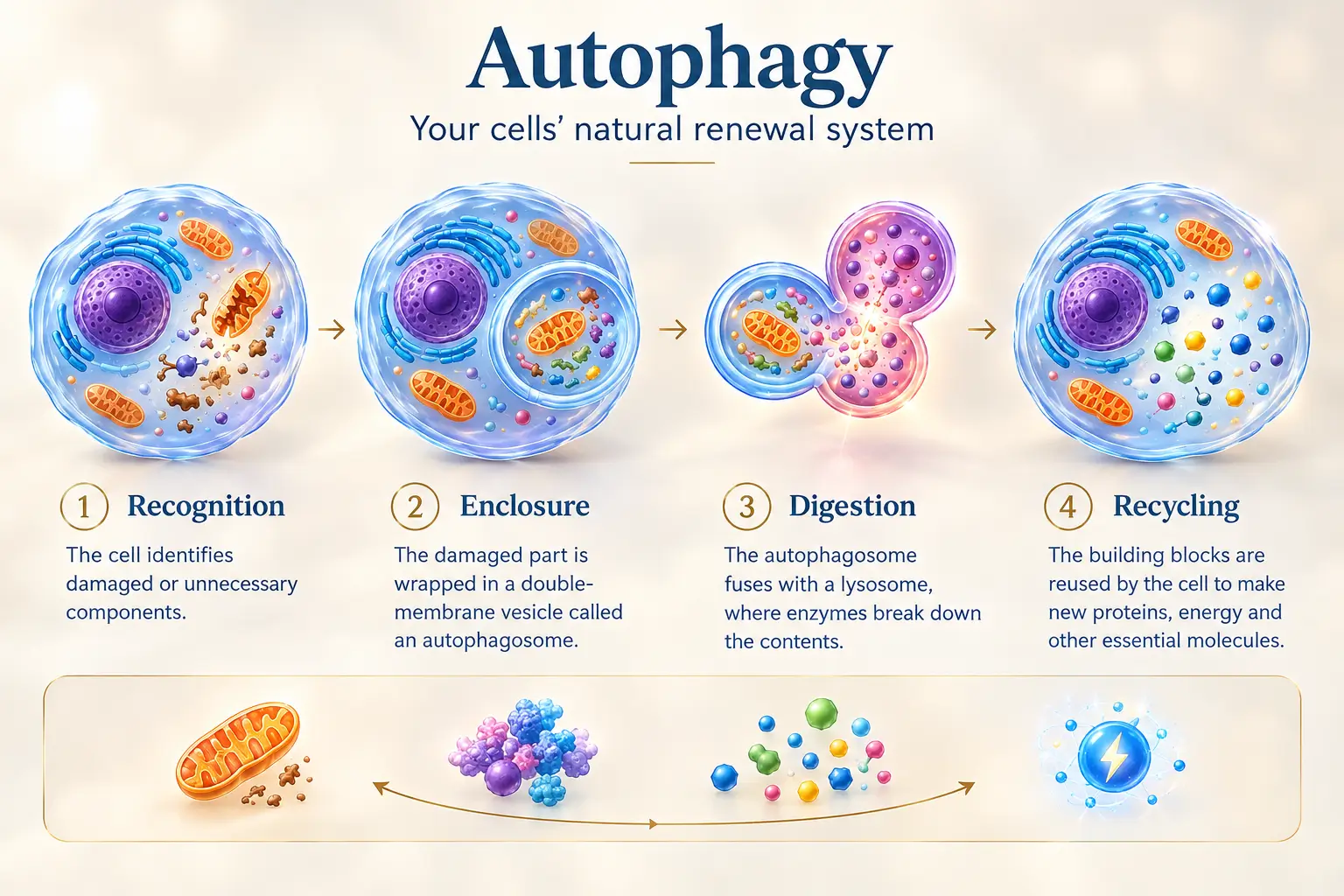
Autophagy (Greek for "self-eating") is a recycling system inside every cell. The cell wraps damaged proteins and worn-out components in a small membrane bubble and delivers them to the lysosome, the cell's breakdown center. The parts are dismantled and the raw materials reused.
Think of a kitchen that never fully closes: even on a normal day, someone is clearing old jars from the back of the fridge. Autophagy runs at a baseline level all the time, not only when you fast. That much is well established.
The Japanese scientist Yoshinori Ohsumi won the 2016 Nobel Prize in Physiology or Medicine for showing how autophagy works, using baker's yeast. Scientists now count declining autophagy among the hallmarks of aging, which is why longevity marketing loves the word.
What autophagy is not: a detox, the same thing as fat burning, or a way of removing whole old cells. Clearing out aged (senescent) cells is a different process, and there's no human evidence that fasting does it.
Does fasting cause autophagy in humans?
Probably to some degree, but nobody can yet say how much, when, or in which tissues. The evidence splits sharply between animals and people.
In cells and animals, the evidence is strong. Starve a cell of nutrients and autophagy rises, consistently. In mice, 24 to 48 hours of fasting markedly increased autophagy in brain cells. Even in mice it depends on the tissue: repeated 24-hour fasts raised autophagy markers in the liver but not in muscle. And a mouse's metabolism runs far faster than ours, so a 24-hour mouse fast isn't a 24-hour human fast.
In humans, the evidence is thin. The problem is measurement. Autophagy is a flow, not a fixed level, and seeing that flow means sampling living tissue over time. Researchers use muscle biopsies or blood immune cells, which tell you nothing about your liver, skin or brain. Here's what the human studies found:
- In a 6-month trial of 121 adults with obesity, autophagy in blood cells differed between the intermittent-fasting group and standard care, but didn't significantly rise from baseline within the fasting group.
- In a study of 42 healthy adults, autophagy in blood cells was no different after an overnight fast than after a protein-rich meal. This is a preprint, not yet peer reviewed.
- In muscle, several autophagy markers actually went down after 8 weeks of intermittent fasting, probably because of the weight loss.
An October 2026 review in Biochemical Society Transactions concluded that evidence for fasting of 24 hours or more stimulating autophagy in humans is limited and inconsistent. A trial measuring autophagy after a 3-day fast in people has been registered but hasn't reported yet.
How sure can we be? Autophagy claims, fact-checked
Here's every claim we see most often, sorted by what the research actually supports:
| What you've heard | What's actually known | Evidence level |
|---|---|---|
| "Autophagy kicks in at 16 hours." | No human study has found a start time. The 16-hour figure is extrapolated from animal and cell research. | Not supported |
| "A 72-hour fast is peak autophagy." | Not measured in humans yet. A 3-day human trial is registered but hasn't reported. | Unknown |
| "Autophagy detoxes your body." | Autophagy recycles parts inside cells. Your liver and kidneys handle detoxification, fasting or not. | Misleading |
| "Fasting clears out old cells." | Autophagy works inside cells; it doesn't remove whole aged cells. No human evidence that fasting does that. | Not supported |
| "Autophagy reverses aging or fixes your skin." | Declining autophagy is linked to aging. No human study shows fasting reverses aging or improves skin through autophagy. | Not supported |
| "Coffee or broth breaks autophagy." | Can't be answered: it assumes an on/off switch that hasn't been measured in people. | Unknown |
| "Fasting increases autophagy." | True in cells and animals. Limited, mixed evidence in humans. | Emerging |
| "Autophagy is essential to health." | Yes. It runs all the time, and its failure is linked to disease. | Established |
The sources for each row are linked above and listed at the end.
So why do a 3-day fast at all?
Because the reasons you can check are good enough on their own. Here's what a 3-day fast does that is well documented:
- It switches your fuel. After roughly a day, your body runs mainly on stored fat and ketones instead of carbohydrate. Established.
- It moves the scale and the tape. Expect several pounds on the scale, about 1 to 2 of them fat. Here's what a 3-day fast realistically does to your weight.
- It resets habits. Many people discover they can be hungry without panicking, and that much of their snacking was routine. That's experience, not a lab finding, but it's the one customers mention most.
- It's a challenge you set and finish. Three days, three stages, and day 3 is the summit.
From the Burnbox community: [ADD: real customer quote about what changed for them after a fast, used with permission, with the name or initials they approved]
Will your cells do some extra recycling along the way? Possibly, and research may confirm it in the next few years. If it does, count it as a bonus, not the reason.
Does a fasting kit "break" autophagy?
Nobody can say, for water fasts or kits, because there's no measured switch to break. What is known: a Burnbox day stays at about 100 calories with very little carbohydrate, so you stay in the same fasted, fat-burning state as on water. Here's how a water fast compares with a Burnbox fast.
Why this matters more after 40
Most autophagy content is aimed at 25-year-old biohackers chasing a number. If you're in your 40s or 50s, the questions worth asking are simpler: will a fast help my waistline, my energy and my habits, and is it safe with what I take? Those have real answers. For a wider view of where fasting fits in healthy aging, see what the research says about fasting and longevity. And if you take medication or have a health condition, read who shouldn't do a 3-day fast first.
Fast for reasons you can check
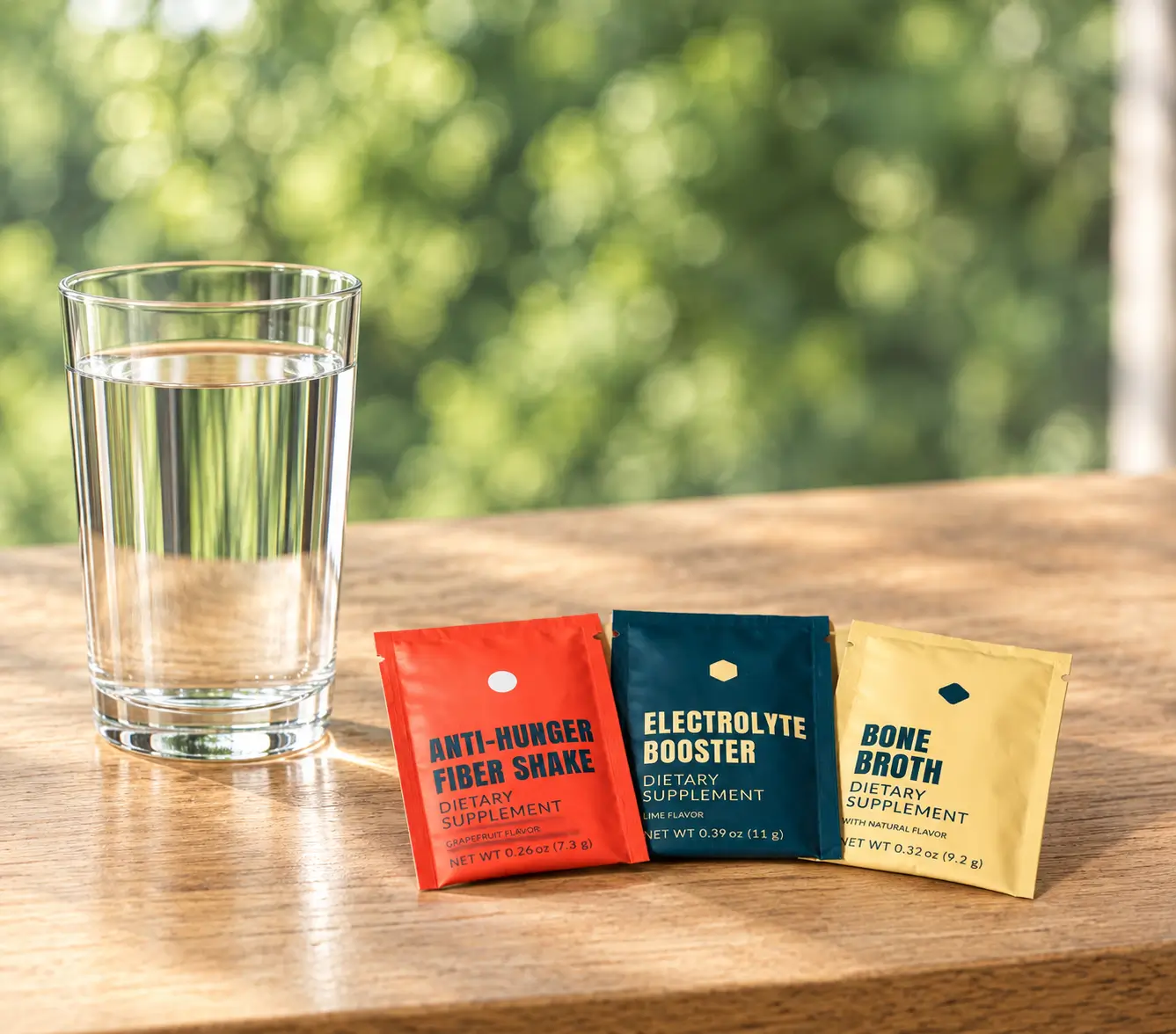
We'll never sell you autophagy. We'll sell you a well-planned three days: measured electrolytes for day 2, a fiber shake for the hunger waves and a hot broth for the evenings, with honest numbers at the end. Proof, not promises. See the 3-day kit
FAQ
When does autophagy start when fasting?
No human study has established a start time. Autophagy runs all the time at a baseline level. Popular figures like 12, 16 or 24 hours come from animal and cell research.
How long do you need to fast for autophagy?
Unknown in humans. The few studies that measured it in human blood cells found small, mixed effects, and none tested a specific fasting length.
Can you test whether you're in autophagy?
No. There's no clinical lab test, wearable or app that measures autophagy. Ketone strips measure ketones, which is a different thing.
Does intermittent fasting (16:8) cause autophagy?
There's no evidence that 16 hours is a threshold. Trials of the 16:8 pattern didn't measure autophagy.
Is autophagy the same as ketosis?
No. Ketosis means your body is making ketones from fat for fuel, and it's easy to measure. Autophagy is cellular recycling, and in humans it's very hard to measure.
Does exercise cause autophagy?
Animal studies suggest it does in muscle. Human results are mixed and depend on how it's measured.